
This body is ~creative~
'I wonder if that was a migraine?' she thought


Fun stuff below, but first —
Paid subscribers: as you know, we’re scheduled for a Write-Along this Sunday. Unfortunately, I’ve got to move it to Saturday instead. And because many of us will be participating in No Kings events on Saturday, I’ve changed the time to 8:00am Pacific. Come write, then shout in the streets?
→ Saturday, March 28, at 8:00am Pacific ←
Note: If people are interested, I’m open to sharing an audio recording of the Write-Along prompt. If you’re unable to attend on Saturday and would like time-limited access to the recording, there’s a spot to say so in the RSVP form.
Also, there are a handful of spots left in the retreat I’m leading in Spain this fall!
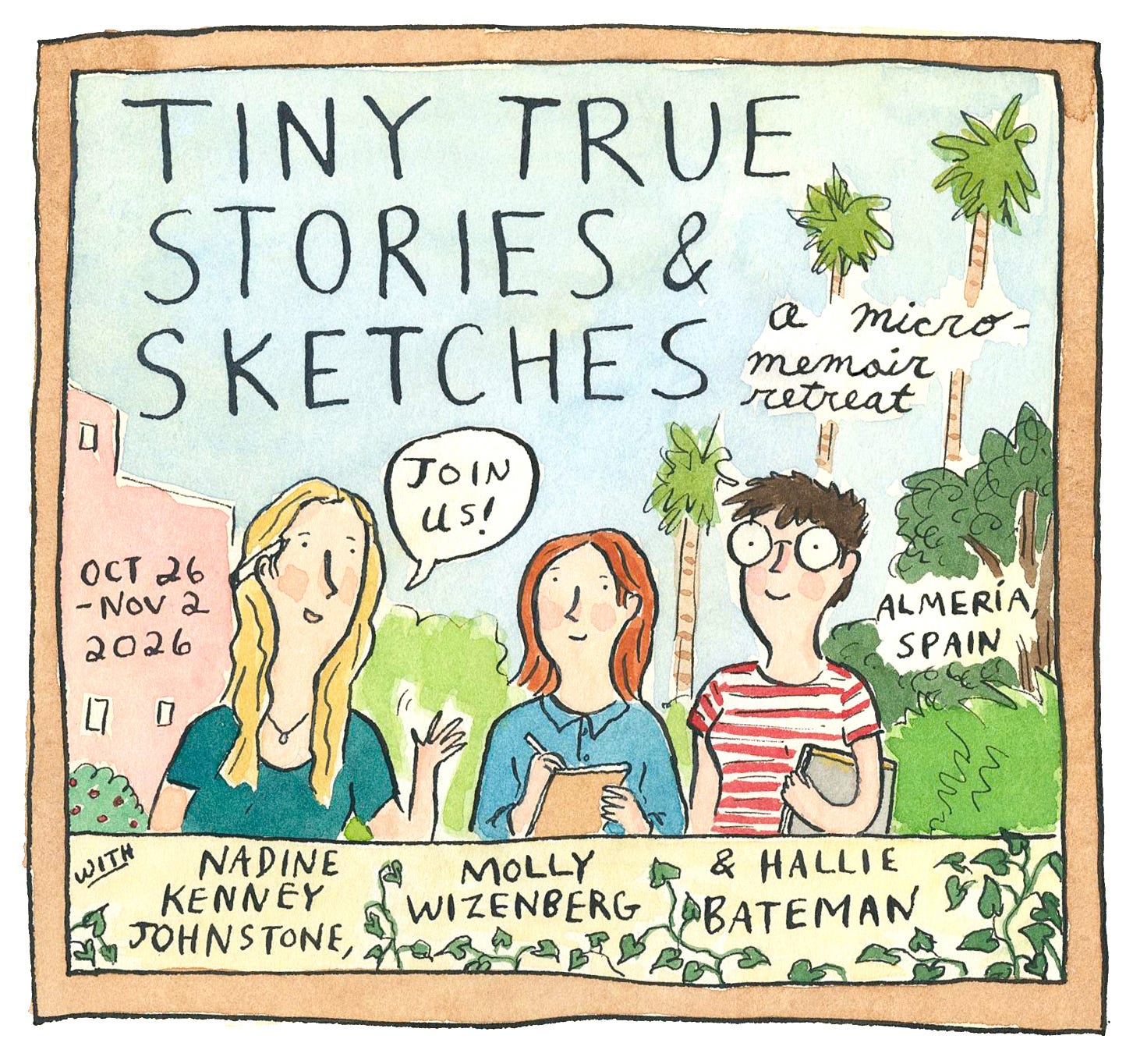
Every book I’ve written has started as a series of fragments, memories and scenes that felt urgent long before I knew they’d become a book, before I even knew why I was writing them. I used to think this meant I was ‘doing it wrong’ (?) 🤪 but by the third book, it started to make sense. Every project starts small. That’s why Hallie Bateman, Nadine Kenney Johnstone, and I are thrilled to lead a week-long retreat focused on micro-memoir, or a series of approaches to making art from the small, often ordinary moments that we call life.
Hallie is a writer and illustrator, the genius brain and hand behind four books, many New Yorker “Shouts & Murmurs,” and much more. Nadine Kenney Johnstone is an author, podcast host, champion of women writers, and a gifted and generous teacher of memoir. Together we’ll spend a week in a villa in southern Spain, exploring micro-memoir in written and sketched forms. Think of it as a creative vacation. It’s open to all skill levels, whether you consider yourself a writer, an artist, or neither. Whatever gets you there, I can say from experience that you’ll leave more alive — with a portfolio of stories and an illustrated travelogue of your own.

I started menopausal hormone therapy six weeks ago. That’s no time at all, really, and certainly not enough time to draw any conclusions. Six years wouldn’t make me an authority on MHT. At six weeks, I can’t even be sure it’s doing anything, because what will indicate that it’s working is the easing of slippery and aleatoric symptoms that I’ve only been able to recognize in retrospect.
I decided to go on MHT after two years of suspecting that my hormonal landscape was changing. By ‘hormonal landscape,’ I wish I meant a style of painting, like maybe we’re strolling together through an exhibit of abstract expressionist masterpieces. What I’m actually talking about is harder to envision. The changes have been subtle, murky.
I’ve had no hot flashes1. I’ve had night sweats for years, but that’s a common side effect of the antidepressant I’ve been on since 2012. Who knows. Likewise, I’ve had irregular periods for as long as I can remember, maybe the entirety of my reproductive life. I remember the first time a friend casually mentioned that her cycle was always 31 days and that she always started bleeding around lunchtime. I stared at her with question marks where my eyeballs had previously been. Until recently, my cycle has ranged from 25 to 42 days. The cycle when I got pregnant with Silas, for example, I ovulated on day 23. For the uninitiated: this would have put me on track for a 46-day cycle. Menstrual irregularity is old news. But what’s new news is that the irregularity itself has gotten more irregular. My cycle length now ranges from 21 to 67 days, the latter span probably best called a missed period? Today is day 44 of my current cycle. Or maybe I’m halfway into my next cycle. It doesn’t really matter. I will not be making another baby, but this body remains creative!
It’s not so bad. It’s my normal. It means that I have to pack menstrual gear every time I travel, which is annoying but fine. Also annoying but fine: the size and shape of my body are changing. That too is subtle. I am someone who lives in a thin body, so I considered not even mentioning it. But bodies of all sizes change, and it’s important to say so loudly. Like most of us, I came out of Covid lockdown with a different body than the one I went in with. I dealt with this by consigning a bunch of pants and buying the next size up. Since then, I’ve sized up two more times — most recently last week, when I finally admitted that the jeans I bought last April are already too tight. This sucks. I love my clothes! Money doesn’t grow on trees! But wearing too-tight pants is a recognized form of torture, and I’m not interested in making myself smaller for a pair of pants or anything else.
All of this remains tolerable. What is not tolerable is the fact that, increasingly, in the days leading up to my period — whose timing, again, I cannot predict — I feel a violent desire to pound my chest with my fists, throw my belongings into a suitcase (along with aforementioned albatross of tampons and pads), set fire to everything else, and leave civilization forever. Irritability was not a part of my menstrual experience as a younger person. But lately, wow.
Out for a walk this past weekend, having white-knuckled through a morning of parenting a typical three-year-old with an ear infection, I listened to a podcast on emotion regulation in which the guest, Marc Brackett, an expert on emotional intelligence, described how he uses compassionate self-talk to cope with a tough day:
I say to myself, Marc, you know this feeling is impermanent. Then I take a breath, which gives me access to my cognitive strategies, and I say, Marc, today’s a rainy day. It’s okay. Tomorrow’s going to be a sunny day.
To which I replied, HAVE YOU SEEN THE WEATHER OUT HERE, MARC? What if I WANT TO RUMINATE, MARC? MARC? WHAT NOW, MARC????
(But I do recommend the episode! It was actually very helpful. And Marc must have heard me screeching because, toward the end, he explained why being dysregulated can feel strangely good, and why you, MOLLY, might resist regulating.)
But it isn’t only that I’ve felt sporadically murdery. What really drove me to ask for menopausal hormone therapy was the realization that the premenstrual headaches I began having two years ago are hormonal migraines.
I was 45. I remember the date of the first one because I was teaching a workshop in Arizona. The headache was persistent enough that, after about 24 hours of discomfort, I decided to tell my students that I wasn’t feeling so good. But the pain wasn’t what I thought a migraine would be: I saw no aura and had no special sensitivity to light, and the pain was not incapacitating. I’d describe it as mild to moderate. What made it different from tension headaches I’d had was its duration, coupled with the fact that over-the-counter medications didn’t help. I was able to teach, didn’t consider not teaching — but I did so with a dogged pain on the left half of my forehead. The next day, as though my body had decided at last to explain itself, I got my period.
This happened three or four more times in 2024. It continued at roughly the same frequency in 2025, always a day or a few before my period began.
I have a well-informed doctor whom I trust, but then a friend gushed to me about the naturopath who’d started her on MHT. In early 2025, I decided to see what her naturopath might tell me. I went to the clinic recommended by my friend and left with a lab order for a battery of tests, which I dutifully got poked for. At my follow-up, the naturopath read through my lab results and made recommendations, including MHT, based on my blood hormone levels. Before filling the prescriptions she gave me, I sent an email to my doctor with the lab results, requesting my doctor’s thoughts. Well, she said. Blood tests are not a good indicator of hormone levels, because hormone levels fluctuate dramatically over the course of one’s cycle. I knew this already, I did; I just hadn’t wanted to think about it. I’d kind of hoped that the naturopath had an inside scoop, some bright shining information that my doctor didn’t have. I’d wanted to feel like my friend felt. Mostly, I think, I’d wanted someone to tell me what to do.
My doctor asked what I wanted to do. Did I want to talk about menopausal hormone therapy? We absolutely could. The best criteria for prescribing it, she explained, would be my symptoms. If I was having symptoms of perimenopause, I was probably in perimenopause, and some of my symptoms might be helped with MHT, which she’d be happy to discuss and prescribe. The problem was, in spite of the evidence cited above, I still wasn’t sure I was having symptoms. Typing this, it seems obvious. Living it, less so.
This past December, I got another one of those headaches, but this time, the pain was firmly moderate, not mild. It began overnight, a thudding gray feeling above my left eye when I got up to pee. The next morning was a Saturday. Our clothes dryer had died the day before. After breakfast, though my head hurt, we set out as a family for Home Depot, where I proceeded to take a rapid turn. Leaving Ash to negotiate the purchase and delivery of our new ($700, zero frills) appliance, I began to pace the bathroom-fixtures aisle, trying not to vomit. I barely spoke on the drive home, then crawled into bed and slept for three hours. When I woke up, the pain was gone. I wonder if that was a migraine? I thought.
Still, it wasn’t until February, when it happened again — the nausea, the half-day spent in bed — that I would google “hormonal migraine” and decide, Yes, that’s it. That was last month.
First, my doctor gave me a prescription for drug designed specifically to treat acute migraines. I’m to take it as soon as I feel one coming on. As for hormone therapy, it’s not FDA-approved to treat headaches or migraines, but that doesn’t mean it does or it doesn’t; it means only that more study is needed. Since my migraines seem to correlate with cyclical hormone fluctuations, my doctor and I decided it’s reasonable to see if MHT helps. Time, as patient people say, will tell. I now wear an estradiol patch on my abdomen, a clear sticker the size of a postage stamp that I change twice a week. Each night I swallow a tiny and perfectly ovoid progesterone pill, the dimensions of which are an exact match for the eggs in a Calico Critters kitchen set.

When you learn about the body in school, you learn its systems, its ordering principles. This compound over here binds to that receptor over there, which tells the cell to release this other compound, which makes X happen to Y, and so on and so on. The human body has a logic, even though it looks like reddish glop in a sack. As a student, I found the body so fascinating, I decided to get an entire B.A. in Human Biology. So I’m not exactly saying that I’m surprised by the reality of living in a human body, but I am astonished by it, again and again. Science can say for certain that your body will do this thing, this x. But no one knows, at first not even you, what x will feel like. Hello, MARC???
The way I am experiencing the winding-down of my body’s reproductive capacities is a lot like my experience of being diagnosed with ulcerative colitis. In both cases, I had symptoms well before I understood those symptoms as a pattern, and before I understood the pattern as having a name. If you’ve read anything about perimenopause, this is exactly what people say: it will be weirder, less definitive, less obvious, both slower and more sudden, than you expect.2
People in positions of power have long prioritized men’s bodies over women’s bodies. Research funds flow accordingly. But nonetheless, even so — for all we know about the human body, for all our scientific methods and empirical evidence, the whole thing remains stubbornly mysterious. How… right? “I may not totally recognize the woman I see when I look in the mirror,” writes the great Angela Garbes, then age 46. “But I am curious about her. I’ll follow her. I think she’s going to take me somewhere interesting.”
I wrote this down because writing is how I make things make sense, the only way I know to transform life into something approximating order. Let the record show: I pushed this rock a little further up the hill! Plus, it was fun. Thank you, always, for reading —
M.
yet
A book I found informative, thorough, and galvanizing: The New Menopause, by Dr. Mary Claire Haver. And my friend Angela, mentioned above, wrote a typically excellent series on midlife for The Guardian. Would love to hear your recs — books, podcasts, articles, essays — in the comments.
I wish facial stripes and bushy tails were a side effect of perimenopause when the rage hits. So everyone around us would know how amazing we are for not losing our shit loudly and violently while still doing all the things.
Yes please to the recording!
And ah, the menopause. It’s different for everyone who experiences it, and I’m out the other side now, but it felt like being on a physical and emotional rollercoaster for YEARS. Recognising it and figuring out what helped was most of the battle.
It’s a time to be kind to yourself. You will change and it’s not always easy but there is freedom on the other side. I feel more myself than I ever have.
Hang on in there.